It Sounds Like the Kitties Asking if I Had Pots Again
Postural Orthostatic Tachycardia Syndrome (POTS) is both mystifying and misunderstood by nearly anybody, including almost doctors. A relatively new illness, POTS still lacks a fix of universally followed, predefined treatment guidelines. (This often results in confusion and frustration amongst patients and their physicians.) Instead of regurgitating the piffling information nigh POTS that can exist institute in medical textbooks, we decided to survey POTS patients (over 900 of them). Past combining the largest survey of POTS patients ever conducted, our experience treating the disease, and the most recent medical literature on the topic, we promise to help demystify the medical mystery that is POTS.
This guide – which we're calling the POTS Center – is intended to be the nigh comprehensive online resource on POTS. The POTS Center will be constantly updated to reflect the most current literature related to POTS. This page includes an overview of the affliction, along with the most notable findings in our survey. Please don't forget that each section has a page dedicated to information technology, where y'all can observe more in-depth data. All content is written by one of MyHeart's volunteer cardiologists and so reviewed by at least 2 others.
And so without further ado, we welcome you to the POTS Center – a pocket-sized identify on the internet where we combine real patient feedback with published information and our own experience treating the disease – with the hope we tin make the lives of those suffering from POTS a little easier.
What Is POTS? A Brief Definition
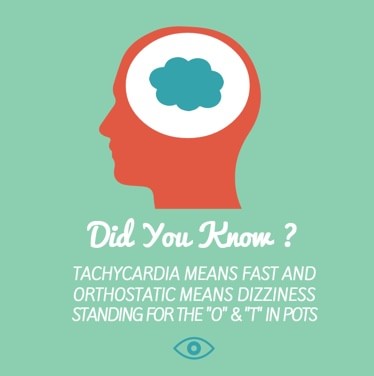
POTS is a grade of dysautonomia that affects the menstruation of blood through the trunk, thereby causing dizziness when standing. Technically, someone has POTS if their heart charge per unit increases by 30 beats per infinitesimal or their centre rate is greater than 120 beats per minute inside 10 minutes of standing upwardly.
The autonomic nervous system regulates involuntary actions that let the torso to function. When we stand up, for example, the body needs to accommodate an entire ready of processes to allow this. Upon standing, a meaning amount of claret automatically falls to the lower body. Autonomic reflexes ensure that blood gets appropriately distributed to the upper body by changes such as muscle tone, vessel tone, middle rate, and pumping responses in the heart.
 At that place is a range of diseases that affect the autonomic nervous organisation known as dysautonomia. POTS is ane of them. In POTS, in that location is increment in eye rate and low-cal-headedness on continuing, likewise as practise intolerance, fatigue, and a multitude of other symptoms. POTS may exist so severe that fifty-fifty normal everyday activities commonly taken for granted such as bathing or walking may be severely limited.
Although anyone can be affected by postural tachycardia syndrome, it is by far most prevalent among adult female in their teens, twenties, and thirties. In that location is a wide spectrum of POTS-like disorders that falls under the umbrella of dysautonomia, several of which practise non accept the increase in center rate.
Symptoms
POTS is most commonly known for causing dizziness upon standing. In some cases, patients actually faint when trying to stand, earning POTS the nickname of "the fainting illness". However, dizziness and fainting are just a few of the many frequently debilitating symptoms POTS patients battle on a daily footing. Additional symptoms include:
- Headaches
- Nausea
- Abdominal pain
- Chronic Pain (Full general)
- Breast Pains
- Heart Palpitations
- Fatigue
- Shortness of Breath
- Insomnia
- Encephalon Fog
- Sweating Abnormalities
- Weakness
- Bladder Dysfunction
- Tremors
According to our survey, fatigue (95.ii%) is the most common symptom – which isn't surprising because the commonality of POTS and Chronic Fatigue Syndrome (CFS). Dizziness when standing is the second most mutual symptom (95.2%), followed by encephalon fog ( 93.one%), and center palpitations (92.0%).
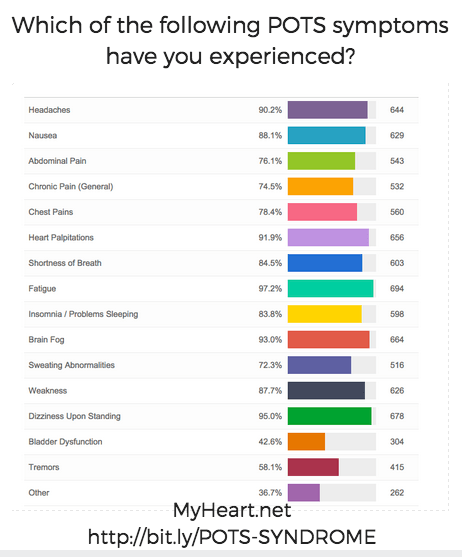
When reviewing these symptoms, it's no wonder POTS is called "the invisible illness" – nearly every symptom is subjective.It'south important to remember that although dizziness is the trademark symptom, POTS does a lot more than than only brand someone giddy.
Of the symptoms, patients study fatigue to be the most problematic or troubling symptom associated with POTS. Fatigue is besides to blame for many of the complications that come with POTS. For example, it's mutual for teenagers with POTS to take a hard time getting to schoolhouse on time in the morning. Patients also find information technology incredibly hard to go out of bed at all. People suffering from POTS tin can notice themselves in a frustrating bicycle – they won't experience better unless they're agile, even so they don't' have the energy to be active. Frustratingly, with POTS the symptom seemingly preclude its treatment, i.e. it'due south very difficult non have a sedentary lifestyle without enough energy to get out of bed, much less run several miles every solar day.
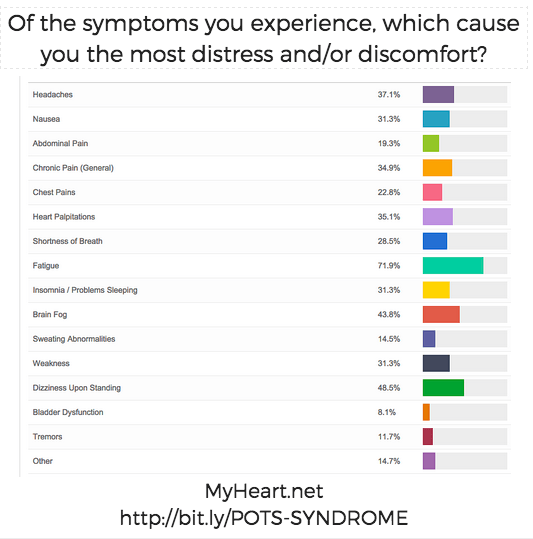
Dizziness (48.v%), encephalon fog (43.viii%), headaches (37.1%), and chronic hurting (34.9%) were rated the most challenging symptoms after fatigue (71.8%). You lot tin can read more about POTS symptomology here. Encephalon fog is a unique symptom associated with POTS. We have a section defended to encephalon fog and POTS here.
Diagnosis of POTS
POTS is typically diagnosed through a multifariousness of tests, the virtually common of which is called a tilt table examination. With this test, patients are strapped to a table which is tilted to simulate the process of standing upwardly by forcing blood from the upper torso to the legs. Tilt tables aren't available at all hospitals, so some doctors diagnose POTS by monitoring changes in center rate and blood pressure while the patient moves from laying down to standing upwards.
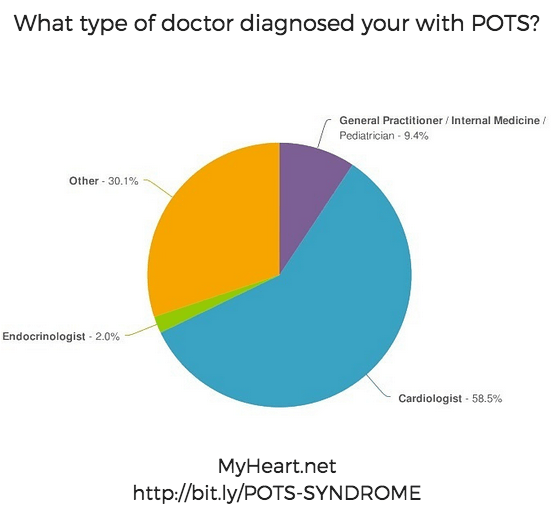
Various types of doctors can diagnose POTS, but our survey found that cardiologists nigh normally diagnose the disease. We should note that a big percentage of respondents who selected "Other" indicated a neurologist diagnosed their status. Click here to read our detailed section of diagnosing POTS.
Challenges Faced by People Beingness Diagnosed with POTS
Unfortunately, individuals often face a number of barriers before and while being diagnosed with POTS. The reasons for this require further research. Nonetheless, it is currently far likewise difficult for patients with POTS to receive proper diagnosis and treatment.
For case, Postural Orthostatic Tachycardia Syndrome is oftentimes misdiagnosed past doctors' as anxiety, panic attacks, depression, or some other psychological disorder. Of those surveyed, over 78% said it was suggested they suffered from a psychological not physical, disorder when being diagnosed.
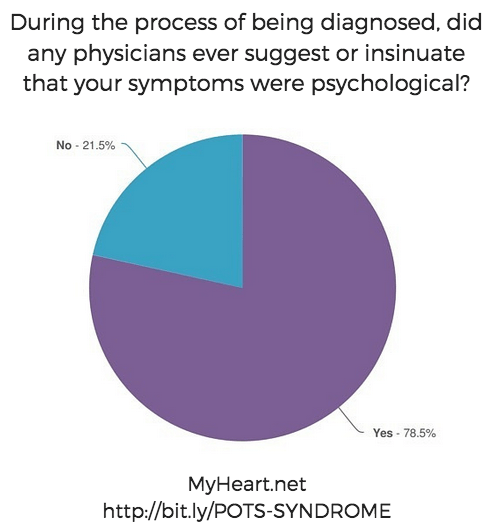
There is no medical evidence that people with POTS are predisposed to anxiety or panic attacks. On the contrary, existing literature suggests individuals suffering from POTS are as likely or less likely to have a mental disorder than the average population.
Another notable finding in our survey is the amount of time patients can suffer from often debilitating symptoms before receiving proper handling. Well-nigh half stated it took more than than ii years to receive a diagnosis.
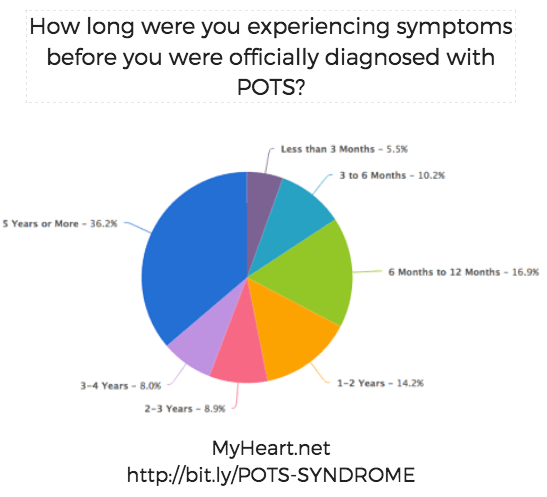
While we don't know the reason information technology's so difficult for patients to receive proper handling for POTS, we can conclusively say that it'southward not considering these patients aren't trying to understand the crusade of their symptoms.
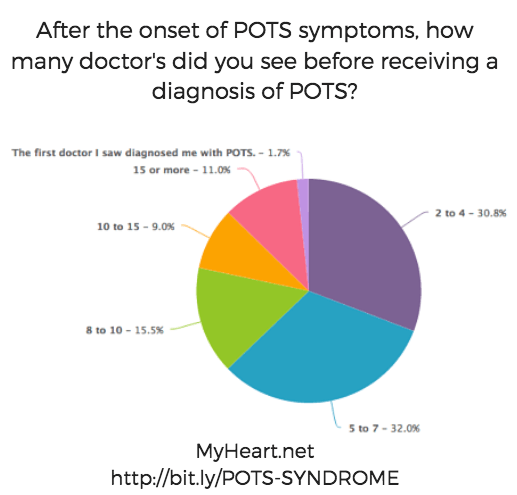
Making this worse – and every bit is the example with nearly any medical issue – receiving a proper diagnosis is key to improving POTS patients' quality of life.
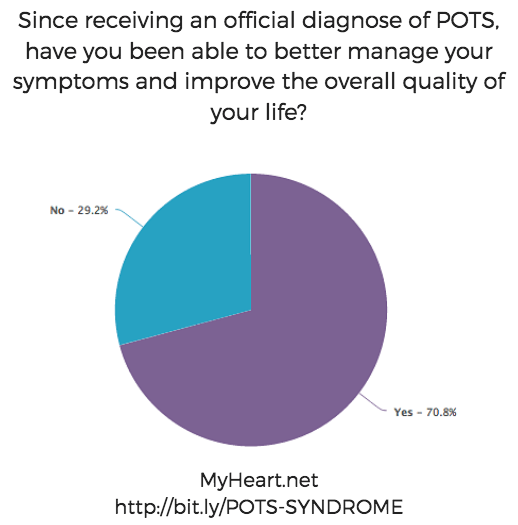
Treatment of POTS
There are iii primary treatments for primary POTS; diet, practice, and medication. Diets that are loftier in sodium and low in gluten have proven to exist constructive in some patients. (You can find more on the all-time POTS diet here.) It's also important that those suffering from POTS exclude sure items from their diet, which you can read more about hither. Exercise has besides been proven to aid patients address some of the symptoms they experience. You lot tin can read more about how exercise helps in this section. Finally, several medications – and combinations of medications – can help to relieve POTS. Click here to read our in-depth section about treatments and specific medications used for POTS.
The About Constructive Treatment?
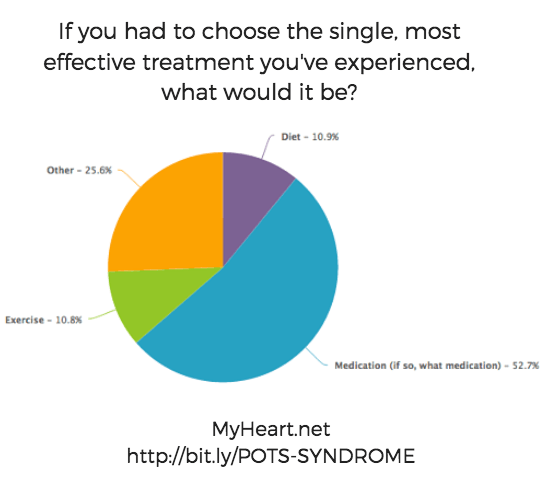
In our survey, we asked patients whatthey plantto exist the most constructive treatment for POTSin their experience. Over 53% indicated medication(due south) were virtually helpful, followed by nutrition (xi.1%) and practice (ten.five%). ("Other" was the second almost common response, with over 25%. We hope to learn more than most these treatments past working with the POTS community in the future.) As physicians, we don't feel comfortable endorsing medication as the single best treatment, because there's so much variation from patient to patient. The all-time form of action is to piece of work with your md to find a treatment plan that works for you. You tin can find scientifically-supported treatments and the corresponding literature in our section detailing POTS treatments.
Types of POTS
Nosotros embrace the types of POTS in more than detail here. In summary, POTS is divided into a few types – neuropathic and hyperadrenergic. Neuropathic POTS relates to a disorder in the nerves that prevent blood from beingness pushed back up to the centre from the legs. Hyperandrenergic POTS is related to high levels of norepinephrine as the source of the symptoms. Furthermore, the disease tin be classified as Secondary POTS. In this classification, the dysautonomia is a outcome of some other condition or illness in the trunk. Click here to find a more detailed explanation of the types of POTS.
What Causes POTS?
POTS is a very complex disease that can have many causes. Generally speaking, causes of POTS are cleaved down into two sections: chief causes and secondary causes. Principal causes of POTS are frequently the source of the disease for younger patients. Some of the primary cause agents of POTS include nitric oxide, neuropathy, concrete deconditioning, and various viruses. Secondary causes of POTS are when another affliction or condition crusade the affliction. Some examples of secondary causes include:
- Anemia
- Adrenal Disorders
- Ehlers-Danlos
- Lyme Disease
- Tumors
- and many others
Read this section on "Causes of POTS" for a much more than comprehensive listing of causes along with supporting medical literature of each.
A Call For Awareness & Understanding
Some estimate that roughly 500,000 people in America suffer from POTS; however, with the difficulty associated with receiving a diagnosis there's no telling how many patients have POTS and don't even know it. While nosotros don't have any brusque-term or easy solutions for these problems or homeopathic cures to provide, in that location are a few points worth making.
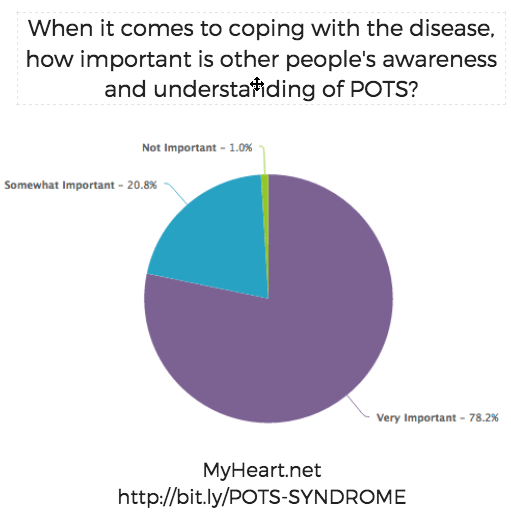
Information technology'south off-white to conclude that increasing awareness about this mysterious disease – not merely amid those who have POTS but among their friends, family unit members, and loved ones – helps the patients manage their status and, perhaps more importantly, believe they tin overcome a challenging condition.
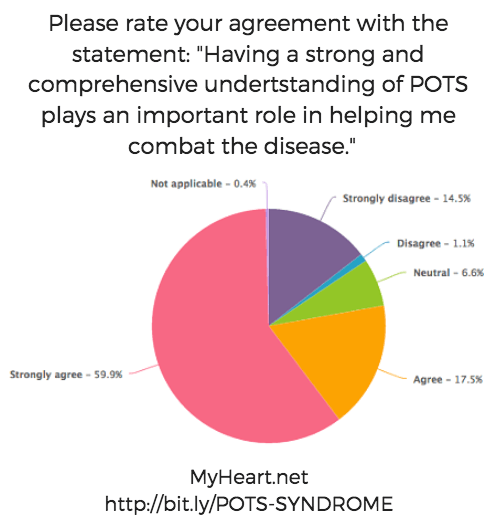
It's this statistic that motivated us to create the POTS Center. We'd encourage you to share this resource – or if not this resource, whatsoever medically accurate and helpful resources on POTS – with anyone you run into fit. You lot never know who may have POTS but, due to challenges mentioned above, never got the diagnosis that could help them regain command over their life.
About the Survey
The survey was conducted via Facebook Groups defended to POTS Syndrome. We asked that merely people with an official diagnosis have part; however, no boosted efforts were made to "proof an official diagnosis". Cheers then much to all of those that participated!
References & Resource
Review Articles
Boyish fatigue, POTS, and recovery: a guide for clinicians. Kizilbash et al. A comprehensive review of POTS, mainly written for clinicians, excellently written.
Postural tachycardia syndrome (POTS). Raj. An excellent review commodity on POTS in a highly reputable journal.
Postural tachycardia syndrome: a heterogeneous and multifactorial disorder. Benarroch et al. A review commodity on POTS.
Source: https://myheart.net/pots-syndrome/

Enviar um comentário for "It Sounds Like the Kitties Asking if I Had Pots Again"